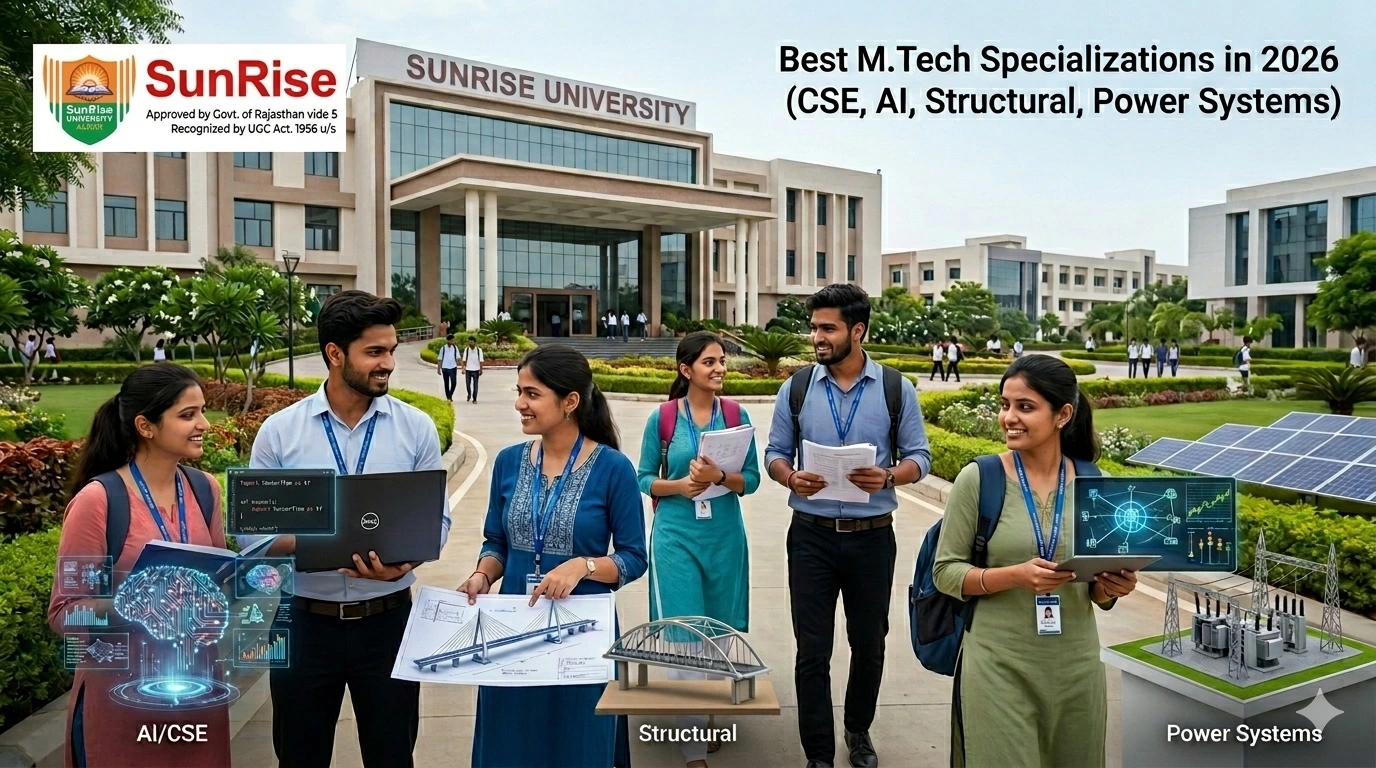
About M.Tech Specializations 2026
The decision of choosing an M.Tech specialization will be a huge decision for your engineering career. The year 2026 will be an era of much more faster developments in engineering disciplines. New domains will emerge while the existing ones will become more complex and efficient.
Therefore if you are looking forward for your higher education then you shouldn’t opt for a branch based on what your peers or family say. Instead ponder upon your own interest, career prospects and the work you want to pursue.
What all students should be aware is that a branch not only defines your initial job profile; it also define your career profile and how well you are growing in your profession.
At present, industries demand engineers with great problem solving and analytical skills and who can also quickly adapt to the current technology.
Choosing a M. Tech specialization: Right path to your career
The few easy questions to be answered before choosing a specialization:
Which subjects do you like to study the most?
Do you love to code, do design work, research work or field work?
Do you prefer a static industry or the ever growing industries?
Compare, compare and compare before applying:
Subjects involved
Placement stats
Industry demands
Growth in salary
Learning prospects
Many students follow trends and they end up with problems. Balance them with future prospects. Traditional core engineering domains still promise good careers but new emerging technologies are throwing open wider opportunities.
M.Tech in Computer Science Engineering (CSE) – An evergreen specialization
What makes CSE still at the top of the chart?
In today’s world, CSE remains one of the sought after specializations. There is hardly any domain that does not use technology. Software runs almost every activity from the business domain such as banking and healthcare to education, defense, manufacturing etc. Students with passion for coding, logic and problem solving pick CSE as their career choice.
Subject matter in CSE M.Tech
Common topics covered are:
Advanced Algorithms
Database Systems
Operating Systems
Cloud Computing
Software Engineering
Computer Networks
In present day, contemporary programs will focus on a few project work and internships as well.
Emerging topics in CSE
Popular programs will highlight on subjects such as:
AI
Cloud Platforms
Cybersecurity
Data Engineering
Distributed systems
Opportunities after M.Tech CSE
You may be appointed to a role such as:
Software architect
Data engineer
System engineer
Cloud specialist
Research Engineer
Technical consultant
Large as well as small start-up organizations are actively looking for individuals with CSE qualifications.
Growth of salary expectations.
Normally, the salary increases as and when you get more technical and gain more experience. Students who have combined programming with practical projects will be ahead.
Promising Areas within M.Tech CSE
Artificial intelligence and machine learning
With AI, machines are given the ability to learn by themselves, and improve by themselves. Companies are using AI for various applications like recommendation systems, automation, predictions etc.
Cloud Computing and Distributed Systems
With growing dependency on cloud platforms, IT organizations now use them to manage applications and data.
Cybersecurity and Ethical Hacking
In today’s world, data security is a crucial component, and skilled hackers are needed to defend networks.
Data Engineering and Big Data Analytics
Organizations have massive data generated at present, and data engineers are needed to convert it to decisions.
Software Development and System Architecture
Development of high scalability systems continues to be a highly rated technological career.
M.Tech in Artificial Intelligence
– Smart Tech of Tomorrow. Why AI would be No.1 Choice as a Career in 2026.
As a growing field with increasing desire for automation and intelligent decisions in companies, AI is booming. It’s the subjects that attract students who love mathematics, coding, experimenting and all such elements.
Subjects commonly taught:
1. Machine learning. 2. Deep Learning. 3. Neural Networks. 4. Computer Vision. 5. Natural Language Processing.
Use cases of AI:
It is currently being used for Medical Diagnosis, Smart assistants, financial institutions, in E-commerce, even for developing self driving cars. The moment you get to shop online with products being listed for you on the basis of your taste, it’s all about the smart use of AI.
M. Tech. In Structural Engineering
– Designing a Robust Future
Reasons to opt for a degree in structural engineering are manifold:
Structural engineering deals with safe and economic construction practices.
As cities are continuously growing and expanding, new constructions such as roads, bridges, buildings and industrial structures will require well-trained structural engineers.
Key concepts covered and subjects included are:
Structural analysis
Earthquake engineering
Steel design
Concrete technology
Foundation engineering
Advanced construction technology
Contemporary engineering utilizes the following tools:
Digital design software
Smart materials
Structural simulation
Building information modeling
Structural engineers contribution to current development:
Structural engineers are primarily responsible for designing sturdy and stable construction structures.
Career prospects:
Some common career opportunities are:
Structural design engineer
Construction consultant
Project engineer/manager
Infrastructure specialist
Government departments are an excellent option due to steady career opportunities.
Demand of qualified structural engineers is also high in overseas construction industries.
M.Tech in Power Systems
-Leading the Energy Transformation
The Relevance of Power Systems today
Electricity has become a way of life and is indispensable for the operations of any industry, cities or renewable energy development project.
This specialization integrates fundamental principles of electrical engineering with evolving energy technologies.
Important technical topics that are covered in the curriculum generally fall under:
Power Generation
Transmission Systems
Smart Grid technology
Electrical automation
Integration of renewable sources in the existing power grid
The modern day power engineer works in the following fields of technologies:
Solar energy systems
Wind energy
Storage technologies
Optimization of grid operations
Career scope for students graduating from this specialization:
Power System Engineer
Energy Analyst
Grid Operations Specialist
Renewable energy consultant
The job market will continue to grow as nations will aim for energy efficiency and renewable energy targets.
Current trends in the top M.Tech specializations
There are a lot of trends which are defining engineers’ careers:
Implementation of AI in conventional sectors
Smart building systems
Development in renewable energy sectors
Industry 4.0 based automation
Combining engineering knowledge with digital skills is expected to hold engineers in good stead.
Top M.Tech Branches: Comparative Analysis
Specialisation
Best For
Growth Potential
Work style
CSE
Coding & software
Very High
Hybrid/Office
AI
Research & innovation
Extremely High
Product & Tech
Structural
Design & construction
High
Field + Office
Power Systems
Energy sector
High
Technical + Operations
CSE Vs AI- Which leads to better growth?
CSE, provides a wider scope for students.
AI enables quick growth for students keen on frontier tech.
Structural Vs Power Systems-Stability Vs Scope
Structural provides durable demands for infrastructure.
Power systems take benefit of the clean energy transition.
Technical knowledge and technical skills alone are not sufficient to acquire a better career path after the completion of M.Tech.
Concentrate on the skills below;
Technical Skills
Programming
Design Tools
Simulation Software
Data Analysis
Industry Certifications
Cloud Certifications
AI Certifications
Project Management Courses
Research and Project Experience
Complete a number of projects practically. Employers highly appreciate hands-on work rather than theoretical information.
Communication and Leadership
Are you able to explain things appropriately? Are you capable of managing people?
These skills may make a difference between a normal candidate and an exceptional one.
Sectors hiring M.Techs in 2026:
IT sector
Construction and infrastructure
Energy and utilities
Manufacturing industry
Research Labs
Tech start-ups
Something very important that students should also be aware of is that companies nowadays require those engineers who are lifelong learners.
Mistakes to Avoid in selecting M.Tech branch
Here are some typical mistakes to avoid:
“Chasing” the trend blindly
You cannot say that AI is the future only because everyone is taking it as an option.
Not considering the long term growth:
Think of five years later.
Pursuing it solely for salary:
Even high salaries cannot compensate the work.
Not looking at the curriculum:
Scrutinize it thoroughly before applying.
Check your future outcomes before admission
Higher Education and Career Growth post M.Tech:
graduation is not an end. Further opportunities like:
PhD and Research
Education Abroad
Teaching
Professional Courses / Certifications,
are still there for the engineers to improve their knowledge and skill, thereby they become highly competitive in this modern world.
M.Tech Specializations – Common Questions
Which M.Tech branch offers the highest salary in 2026?
The field of AI and advanced CSE seems to have highest growing salaries in 2026.
Is AI better than CSE in the long term?
AI is a specialization, whereas CSE offers broad exposure.
Which specialisation leads to better placements?
CSE and AI have excellent placement statistics at the moment, however placements will always depend on skills.
Is M.Tech worthwhile in 2026?
Yes, if you are keen to specialize in some field, to have technical advancements, and better career options.
Conclusion
Selecting an M.tech specialization is not about following trends. It is about carving a career path that suits you. If you are opting for higher studies then be careful when you are making the selection. Take a thorough look into the syllabus, check industry demands, speak to industry people and above all go with a branch you are enthusiastic enough to study for years.